
In hot and humid climates such as Houston and throughout Southeast Texas, air conditioning is one of the most important—and often most expensive—systems in a home or commercial building. Beyond comfort, HVAC performance directly impacts energy consumption, indoor air quality, humidity control, and long-term equipment reliability.
Typical HVAC Design Considerations
Proper HVAC design requires evaluating numerous factors, including:
- The size and layout of the building.
- Local climate conditions and outdoor design temperatures.
- Desired indoor temperature and humidity levels.
- Occupancy patterns and building usage.
- Local utility costs.
- Expected ownership timeline.
- Internal heat loads from occupants, appliances, and equipment.
- Construction quality, insulation performance, and window specifications.
- Equipment availability, serviceability, and long-term manufacturer support.
Each of these factors contributes to determining the appropriate system capacity and overall design strategy.
The Early Years
For many decades, HVAC equipment was frequently sized using simple “rules of thumb” based largely on square footage. While convenient, this approach often resulted in equipment that was larger than necessary for the building it served.
As systems were replaced over time, contractors commonly installed new equipment matching the size of the existing equipment, perpetuating oversizing issues that may have originated years earlier.
Oversized equipment can create several problems. While it may cool the air quickly, it often does not run long enough to effectively remove moisture from the indoor environment. As a result, occupants may experience uncomfortable humidity levels even when the thermostat indicates the desired temperature has been reached.
The Transition to Load Calculations
As building science evolved, the industry increasingly adopted detailed load calculations based on ACCA’s Manual J methodology. Manual J evaluates factors such as insulation levels, window performance, occupancy, orientation, infiltration, and climate conditions to estimate a building’s heating and cooling requirements.
When properly performed, a Manual J calculation is an important component of system design and helps reduce the risk of oversizing or undersizing equipment.
However, even a well-designed system may not always deliver optimal performance once installed. Ductwork restrictions, airflow imbalances, zoning strategies, construction variations, occupancy changes, and equipment settings can all affect real-world operation.
This is where measurement and performance analysis become valuable.
The Challenge
For this project, KSH was contacted by a homeowner who was experiencing persistent comfort issues throughout the home.
The family’s concerns included:
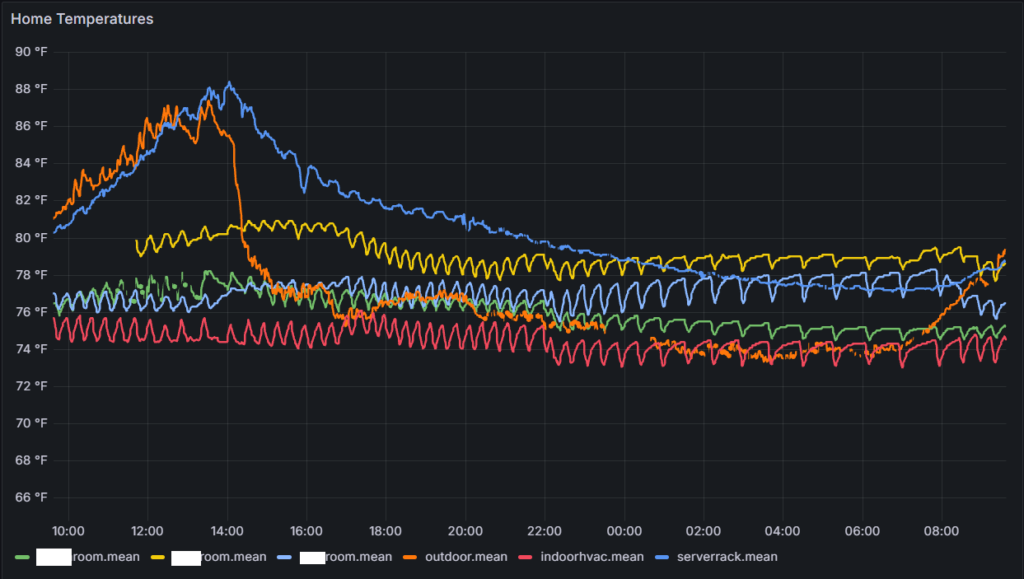
- Significant room-to-room temperature variations, with some rooms exceeding 81°F while others remained near 72°F.
- Excessive system runtime when attempting to compensate for hotter rooms using remote temperature sensors.
- Frequent short-cycling during mild weather conditions.
- Inconsistent comfort despite multiple contractor visits.
During summer operation, one bedroom routinely reached 80°F while other areas of the home remained near 72°F. This eight-degree temperature spread left some family members uncomfortable despite the HVAC system operating for extended periods.
Previous attempts to solve the problem focused on adding controls and sensors, but these measures often resulted in excessive system runtime without addressing the underlying cause.
The homeowner had consulted multiple HVAC contractors over several years. While various recommendations were made, the root cause of the problem remained unresolved.
Our Approach
Rather than relying on assumptions, KSH deployed a network of custom-designed wireless environmental sensors to capture data throughout the home.
These compact devices continuously collected:
- Temperature
- Relative humidity
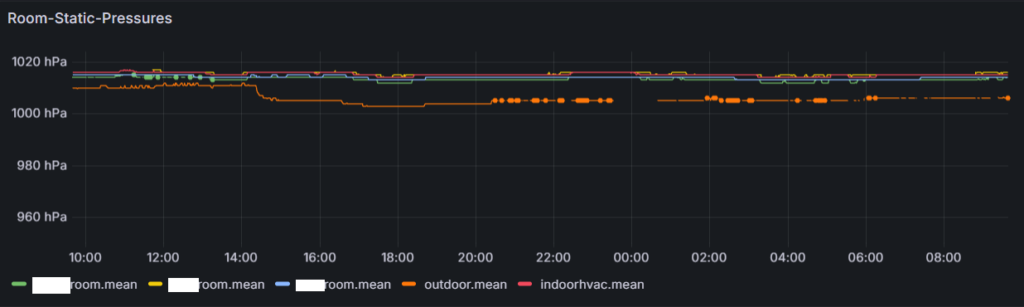
- Air pressure
- Equipment runtime data
- Additional environmental measurements
The information was recorded in our analytics platform and visualized through a series of engineering dashboards.
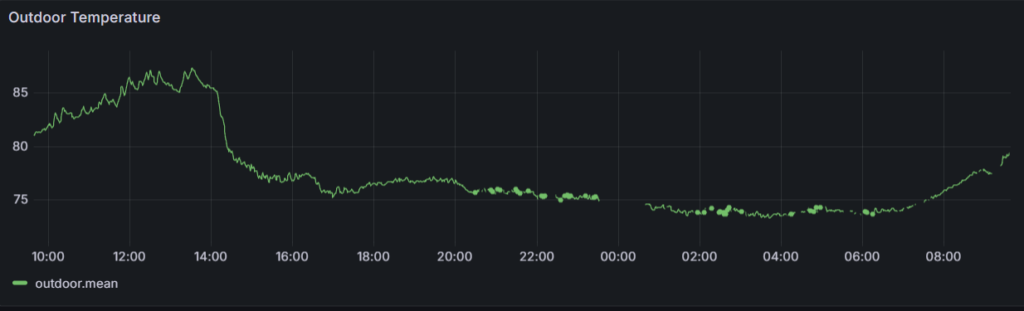
By observing the home’s performance over time, we were able to identify exactly when short-cycling occurred, how temperature differences developed throughout the house, and how those conditions correlated with outdoor weather and system operation.
The data revealed patterns that would have been difficult—or impossible—to identify during a traditional service visit.
The Results
Using measured performance data, KSH developed a targeted re-balancing and strategy that improved temperature consistency throughout the home while reducing unnecessary system runtime.
The solution required no equipment replacement and no invasive construction.
Most importantly, the family achieved significantly improved comfort throughout the home. System operation became more consistent, room-to-room temperature variation was reduced, and overall energy consumption decreased.
Engineering Beyond Rules of Thumb
Design calculations remain an important part of HVAC system design. However, once a system is installed, real-world performance data provides a powerful tool for identifying issues that cannot be discovered through design documents alone.
At KSH, we combine building science, custom instrumentation, and data analytics to understand how systems actually perform—not just how they were intended to perform.
The result is a more informed, engineering-driven approach to comfort, efficiency, and HVAC optimization.